Critical evidence lives everywhere.
- Inconsistent capture
- Missing measurement context
- Repeated review questions
- Manual quote translation
Engineer-supervised DCIA intelligence
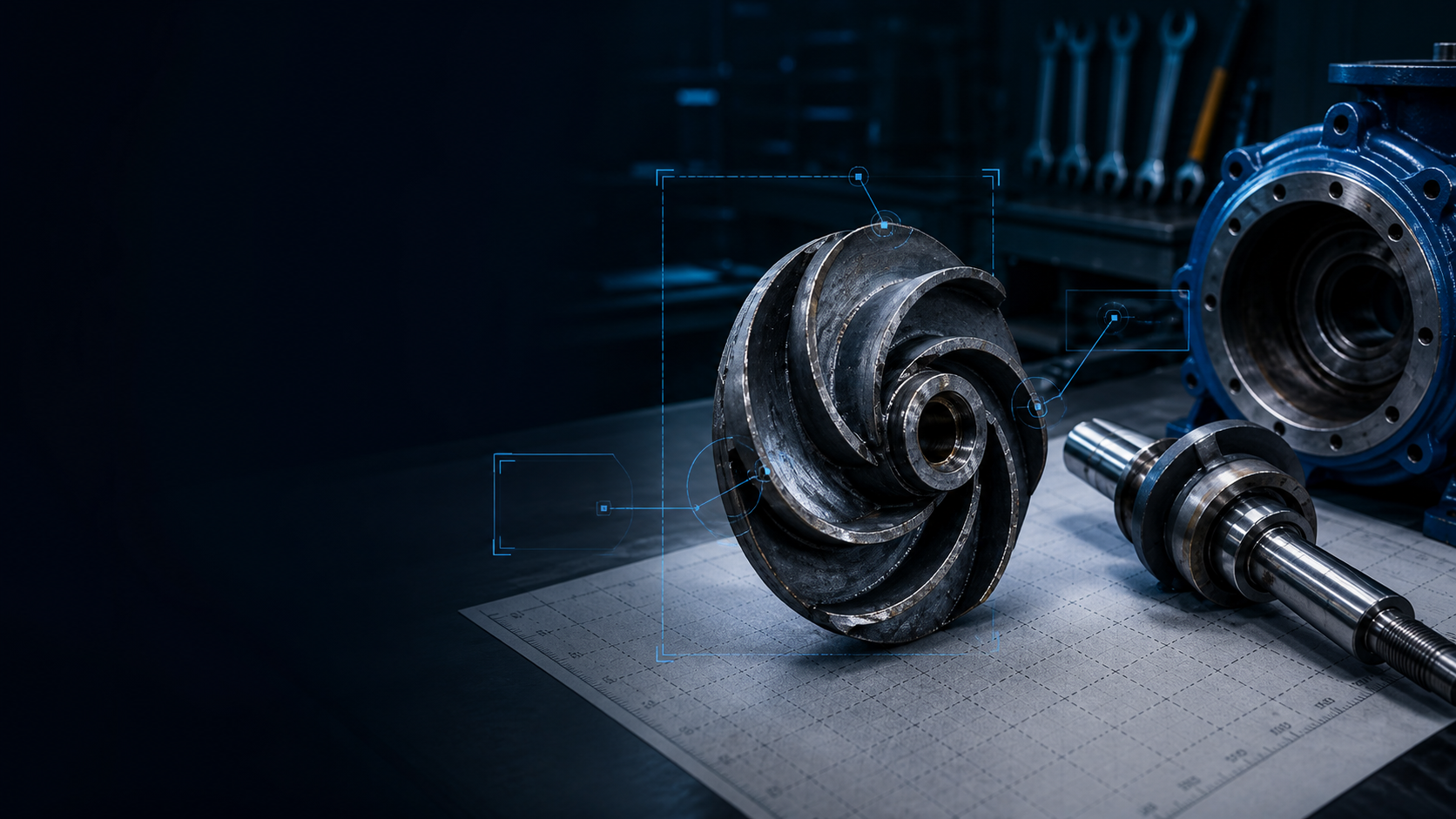
ARIA starts with the equipment tag, guides mobile photo and measurement capture, and records what the engineer sees—then turns confirmed evidence into a traceable assessment report for authorized engineer review and estimating.
 OUTSIDE Ø214.98 mmRUNOUT0.05 mmEVIDENCE12 / 12
The assessment gap
One closed loop
Every output stays connected to the evidence, criteria, version, and person responsible for the decision.
Capture the equipment tag and model, confirm detected pump parts, then collect required views, measurements, and time-coded narration—even when the connection is unreliable.
Structure observations, severity, disposition, confidence, and follow-up with direct citations to photographs, measurements, and approved transcript timestamps.
Compare evidence and criteria side by side. Correct, request recapture, place on hold, or approve with full attribution.
Publish a versioned assessment with component findings, recommended work, approved field-note summaries, and a numbered photo appendix—then reconcile the estimating handoff.
A decision, not a black box
When evidence is missing, contradictory, low-quality, or outside validated coverage, ARIA requests review instead of forcing an answer.
Multi-shop by design
One organization can govern many shops without flattening local expertise. Configuration inherits deliberately, data stays scoped, and rollout happens by measured cohort.
Identity, security, data-use controls, entitlements, and privacy-safe aggregate metrics.
A precise product boundary
Condition-monitoring platforms help teams understand operating assets. ARIA’s proposed focus begins with confirmed equipment identity and follows disassembly, cleaning, inspection evidence, engineer narration, assessment approval, and estimating handoff.
Tag-first identity, technician-confirmed part detection, component capture plans, measurements, audio timestamps, and provenance define the record.
OCR, object detection, transcripts, and assessment output remain candidates or drafts. AI output is always a draft; named, authorized reviewers own the final technical assessment and disposition.
ARIA produces an approved assessment package and reconciles the handoff to the system already creating and releasing the quote.
Trust architecture
Designed around tenant isolation, least privilege, immutable provenance, and a default policy of no shared-model training on customer evidence.
Discuss your requirements ↗Organization roles never imply unrestricted access to raw shop evidence.
Evidence hashes, rule, taxonomy, prompt, and model versions remain tied to the draft.
Approvals record identity, authority, timestamp, version, disposition, and reason.
Capture and manual findings continue if AI or ERP integrations are unavailable.
Standardize before scale
Begin with a 4–6 week baseline and approved standard work. Then validate identity, controlled photography, voice capture, calibrated measurements, completeness, and human approval across 12–20 real jobs—before advanced scanners or defect AI.